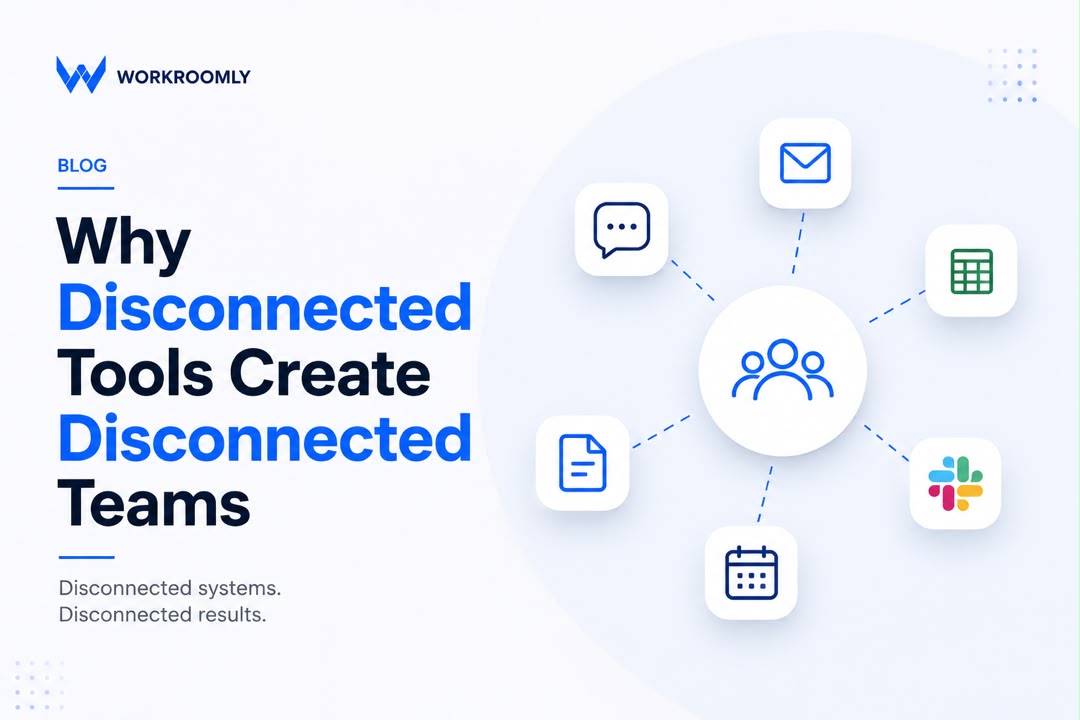
Modern businesses rely on more digital tools than ever before.
Email platforms.
Messaging apps.
Project management software.
Spreadsheets.
Calendars.
CRM systems.
Video conferencing tools.
Each application solves a specific problem.
But when these tools fail to work together, they often create a much bigger one.
Instead of helping teams collaborate more effectively, disconnected systems create disconnected teams.
Information becomes scattered.
Communication becomes fragmented.
Work slows down.
And productivity suffers.
The issue isn't the number of tools a business uses.
The issue is that those tools don't share the same workflow.
More Tools Don't Always Mean Better Productivity
Businesses often believe adding another software solution will improve efficiency.
Need better communication?
Add another messaging platform.
Need better project management?
Purchase another application.
Need customer tracking?
Subscribe to another CRM.
Over time, employees find themselves switching between multiple platforms just to complete a single task.
Instead of simplifying work, technology begins adding complexity.
Every new tool introduces another place where information can become isolated.
Information Lives Everywhere
One employee keeps client notes in a spreadsheet.
Another stores project updates inside a project management app.
Sales conversations happen through email.
Customer questions arrive on WhatsApp.
Meeting notes sit inside shared documents.
Nothing exists in one place.
As a result, employees spend valuable time searching for information instead of acting on it.
Questions become common:
- Where was that conversation?
- Has this client already been contacted?
- Which version of the document is correct?
- Who owns this task?
The answers should be immediate.
Instead, teams waste time piecing together scattered information.
Communication Becomes Fragmented
Disconnected tools create disconnected conversations.
A customer request may begin through email.
Continue on WhatsApp.
Move into Slack.
Finally appear during a meeting.
Without a shared workspace, context disappears.
Employees repeat questions.
Important details get missed.
Miscommunication increases.
Clients receive inconsistent updates.
Strong collaboration depends on shared visibility.
Without it, communication becomes reactive rather than coordinated.
Collaboration Starts to Break Down
Successful teams rely on transparency.
Everyone should know:
- What work is in progress.
- Who owns each task.
- What deadlines exist.
- Which projects require attention.
Disconnected systems make collaboration difficult.
Departments begin working independently instead of together.
Sales may not know what customer support promised.
Operations may not know which deals are closing.
Marketing may launch campaigns without understanding customer feedback.
The business becomes divided into information silos.
Managers Lose Visibility
Leadership cannot improve what they cannot see.
When work exists across disconnected tools, managers struggle to answer important questions.
Which projects are delayed?
Which clients need attention?
Where are bottlenecks occurring?
Which team members need support?
Without centralized visibility, decisions become based on assumptions rather than data.
Customers Notice the Difference
Internal inefficiency eventually becomes visible to customers.
Clients experience:
- Delayed responses.
- Conflicting information.
- Forgotten requests.
- Missed deadlines.
- Repeated questions.
These issues reduce confidence.
Customers may never see the disconnected tools.
But they always experience the disconnected service.
Connected Workflows Create Connected Teams
High-performing businesses focus less on adding more software and more on connecting work.
When communication, meetings, tasks, client information, and project progress exist in one shared workspace:
Teams collaborate faster.
Information becomes accessible.
Responsibilities stay clear.
Customer experiences improve.
Instead of chasing information, employees spend their time creating value.
Final Thoughts
Disconnected tools rarely fail individually.
The problem appears when businesses expect disconnected systems to produce connected teamwork.
Growth requires alignment.
Alignment requires visibility.
Visibility requires connected workflows.
Businesses that centralize communication, collaboration, and customer management create teams that move faster, work smarter, and deliver a better experience for every client.
Because connected teams are built on connected systems not disconnected software.