Know what you own. Know where it is. Know what comes next.

Know what the company owns, who is responsible and what should happen next. Follow assets through custody, care, compliance, value and end of life.

For asset managers, facilities teams, finance and equipment custodians.

  • No card required
  • Start with one workflow
  • Expand at your pace
Assets · WorkroomlyProduct view
An asset is never just an item in a register.Assets connects ownership, custody, condition, cost, policy, maintenance, and operational impact across the company.
Account completely
Move responsibly
Protect availability

The register says what you bought. It rarely tells you what the business can rely on.

Ownership, custody, condition, maintenance, warranty, book value, and disposal often live in separate sheets and conversations—until something is missing or unavailable.

When the process is fragmented

  • Asset records stop at purchase date, serial number, and original cost
  • Assignments and transfers happen without a reliable chain of custody
  • Maintenance and inspection dates depend on calendars or someone’s memory
  • Finance, operations, and People reconcile different versions during audits and offboarding

When Assets is connected

  • Every asset carries identity, category, location, vendor, documents, cost, and lifecycle status
  • Assignments, returns, transfers, condition, and acknowledgements preserve custody history
  • Maintenance, inspections, warranties, and downtime are planned before operations are affected
  • Depreciation, disposals, reports, People, Finance, Procure, BI, Pulse, and CoBrain use one record

Assets is designed around the movement—not the menu.

Each capability stays connected to the customer, work, people, decisions, and operating context around it.

Establish the record and the custodian.

Maintain the asset register, locations and assignments, then follow transfers and returns with the asset’s history.

  • Register, categories and locations
  • Custody, assignments and transfers
  • Returns and verification

Keep the asset useful and covered.

Handle issues, maintenance requests, work orders and inspections alongside warranties, insurance and compliance records.

  • Maintenance and work orders
  • Inspections and condition
  • Coverage and compliance

Manage value and the final decision.

Review depreciation and financial lifecycle records, then retain the evidence around impairment, replacement or disposal.

  • Depreciation and book value
  • Valuation and financial events
  • Disposal and end-of-life review

Everything the workflow needs. One coherent operating surface.

Begin simply, configure deeply, and keep the system understandable as the business grows.

Register & custody

Make responsibility visible.

  • Maintain asset records, categories, identifiers, departments and locations.
  • Track assignments, transfers, custody and returns.
  • Verify assets and review their activity history.

Maintenance & care

Keep issues connected to the asset.

  • Capture issues and maintenance requests.
  • Manage maintenance schedules, work orders and inspections.
  • Track condition and the evidence around completed care.

Coverage & compliance

See the obligations around ownership.

  • Maintain warranties, insurance policies and claims.
  • Track compliance documents, licenses and certificates.
  • Review coverage and renewal records with their supporting evidence.

Value & financial lifecycle

Explain the asset’s carrying value.

  • Manage depreciation entries and schedules.
  • Review valuation, impairment and book-value context.
  • Follow controlled financial events and Finance-linked obligations.

End of life & reporting

Make retirement an accountable decision.

  • Manage disposal and end-of-life records.
  • Review requests, custody, care and lifecycle reporting.
  • Keep decisions and audit history attached to the asset.

Useful details before you start

Employee actions stay close to the asset

Pulse exposes member asset actions such as reporting an issue and returning an assigned asset. Administrative lifecycle and financial actions remain permissioned.

Financial values have controlled actions

Depreciation submissions, reversals and lifecycle financial events use explicit actions and retain their record history.

Owned vehicles in the fleet

Transport can reference active Assets when an owned vehicle is added to the fleet. Keep asset custody and lifecycle controls in Assets, and manage dispatch, vehicle schedules and recorded fleet activity in Transport.

Every lifecycle surface. One record underneath.

Move from a portfolio question to the exact record, owner, event, policy, or action—without losing the lifecycle around it.

01

Overview

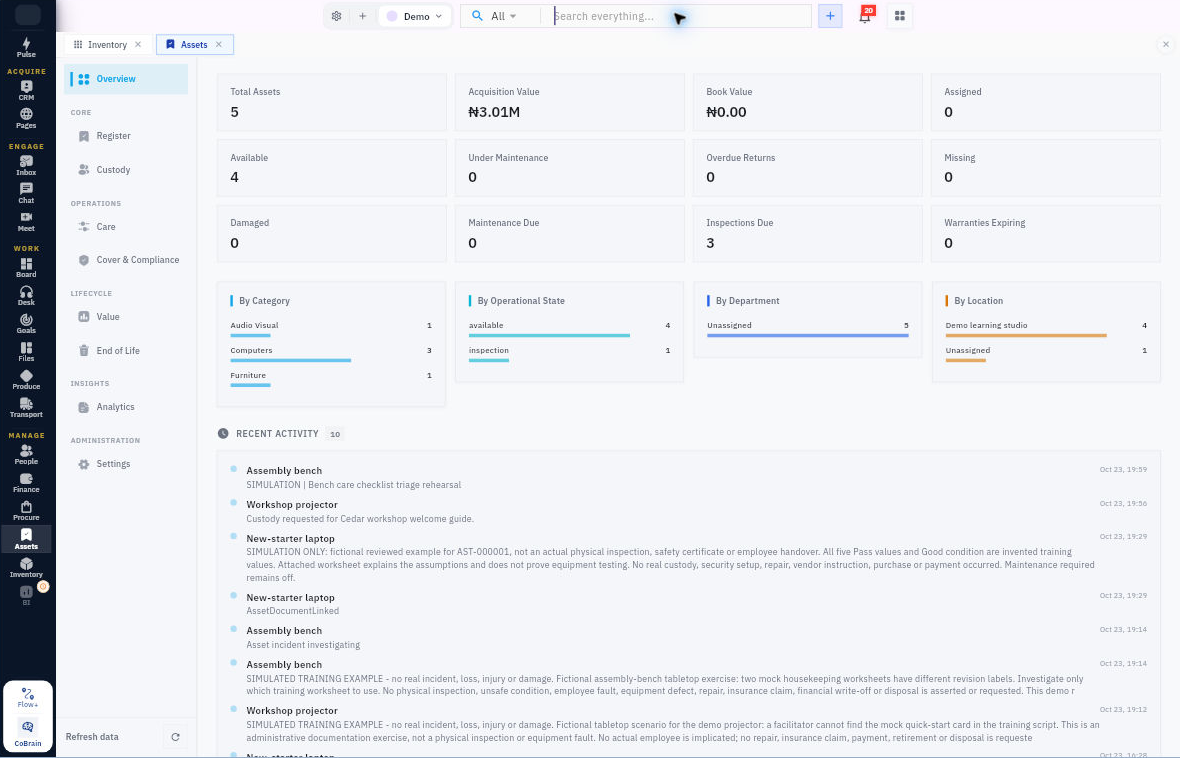
Portfolio health, value, availability, movement, and actions due.

02

Asset Register

The complete, configurable source of truth for every asset.

03

Assignments

Current custody, acceptance, return dates, and responsibility.

04

Transfers

Controlled movement between people, teams, projects, and locations.

05

Maintenance

Preventive schedules, repairs, downtime, costs, and service history.

06

Inspections

Checklists, findings, condition evidence, exceptions, and follow-up.

07

Warranties

Coverage, claims, providers, documents, terms, and expiry.

08

Depreciation

Useful life, methods, book value, impairment, and finance context.

09

Disposals

Approval, sale, donation, loss, write-off, evidence, and proceeds.

10

Reports

Portfolio, utilization, cost, condition, compliance, and audit views.

11

Settings

Categories, fields, numbering, policies, statuses, permissions, and rules.
From assignment to care and accountable retirement.

A practical sequence your team can review and own.

01

Register

Record the asset and its business context.

02

Assign

Establish custody and location.

03

Care

Handle issues, inspections and maintenance.

04

Review

Assess value, coverage and end-of-life decisions.

One product. Clear value at every altitude.

For Operations teams

Operations teams

Know what the company can rely on across locations, projects, facilities, vehicles, equipment, and shared resources.

For Finance and procurement

Finance and procurement

Connect acquisition, vendor, warranty, maintenance cost, depreciation, disposal, and audit evidence.

For People, IT, and facilities

People, IT, and facilities

Coordinate equipment custody, workplace assets, inspections, returns, transfers, and offboarding without reconciliation.

Start informed. Expand confidently.

The strongest rollout is the one your team can understand, adopt, and prove.

No. Assets includes custody, maintenance, inspections, coverage, compliance, financial lifecycle and end-of-life workflows.

Yes. Member-facing asset actions in Pulse include issue reporting and asset returns, subject to the available permissions and workflow.

Yes. Depreciation entries and schedules support the asset’s value history alongside valuation and financial lifecycle records.

Run every asset as part of the business—not outside it.

Start with the category where custody, maintenance, or audit confidence is weakest and build one trusted lifecycle from register to retirement.