Goals course 01 — Understanding goals, objectives and measurable results
Goals connects a desired improvement to objectives, measurable key results and contributing work. The hierarchy makes the purpose visible, but a link or percentage does not prove the improvement occurred. Begin by defining what you will count and why it matters.
Part of Goals module course
In this lesson
Goals hierarchy and measurement boundaries
Goals connects a desired improvement to objectives, measurable key results and contributing work. The hierarchy makes the purpose visible, but a link or percentage does not prove the improvement occurred. Begin by defining what you will count and why it matters.
In this chapter
- Navigate to the exact result
- Design a small, useful measurement contract
- Calculate progress separately from activity
- Keep three visible indicators distinct
- Check your interpretation
Navigate to the exact result
Open Goals > Goals in the intended workroom. Read the active period, year, date and progress filters before concluding that an item is missing. The inspected list included All quarters, All Years, Date Any and All progress choices.
Expand the goal, then its objective, then the key result. Use the key result's square-arrow Open detail control to read the full Measurement, Owner, Team, parent chain, Progress, Confidence and Status. A narrow row can clip a measurement; the full detail is the appropriate place to compare it.
A Goal states the wider improvement. An Objective organizes a purposeful part of that improvement. A Key Result, or KR, states the observable result and target. A task produces contributing work; it is not automatically the measure itself.
Design a small, useful measurement contract
Use this fictional example throughout the course: make a practice welcome instruction understandable. The objective is to prepare clear instructions. The KR is that three independent practice readers can identify the required materials and first action from the same final version.
The complete instruction is: “Bring one sheet of paper and a pen. Start by drawing boxes labelled Output, Owner and Check.” A reader passes only when they independently name both materials and all three box labels. A prompted response does not count as an independent pass. An unperformed check contributes no pass. The fixed target is three reader checks, not only those already attempted.
This contract defines population, unit, method, pass rule and target. It is intentionally a training-comprehension measure, not proof of workplace productivity or customer satisfaction. Do not rename a preparation count as a wider business outcome.
| Element | Example choice | Why it matters |
|---|---|---|
| Population | Three agreed practice reader checks | Prevents changing the denominator when work is missing |
| Source | Exact instruction version | Prevents combining incompatible drafts |
| Unit | Independent successful checks | Separates people, attempts and task completion |
| Target | 3 | Defines what complete means for this measure |
| Evidence | Full response, assistance flag, version and time | Lets another reviewer reproduce the classification |
| Period | The agreed practice review period | Prevents old responses silently counting in a new commitment |
Calculate progress separately from activity
Suppose reader A answers correctly, reader B names only paper, and reader C has not attempted the check. The valid result is 1/3, approximately 33.3 percent. Attempted coverage is 2/3, approximately 66.7 percent. These answer different questions.
The unperformed check is not evidence that reader C failed personally. It simply does not supply a pass toward the fixed target. Counting one pass out of two attempts would answer an attempted-pass-rate question, not completion of the agreed three-check result.
A completed writing task cannot change those responses. It may make the instruction ready to test, but the evidence still determines the KR. Likewise, a target to reduce time needs a baseline and an agreed improvement formula; “current divided by target” is not a universal progress calculation.
Keep three visible indicators distinct
Progress expresses the recorded degree of result attainment. Confidence expresses a separate assessment whose meaning your team must agree. Status names the current state or health. Do not use Confidence as a second progress slider.
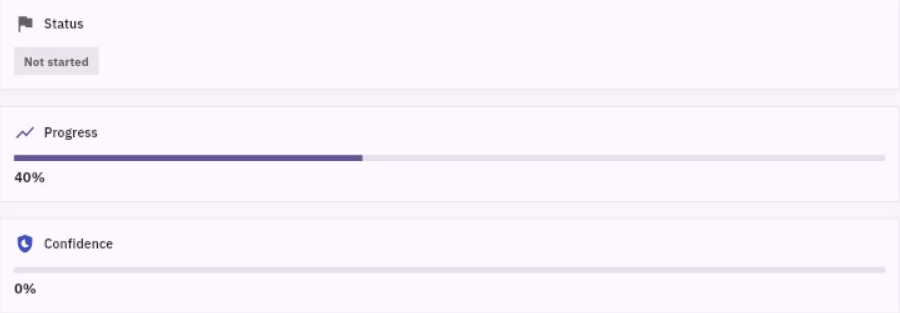
Parent scope and outcome evidence
A child KR can have progress while its objective and goal remain at zero. Do not promise automatic rollup, weighting or status propagation. Open each level and report its actual values.
Check your interpretation
A task is Done, a KR shows 100 percent, and no underlying reader responses are available. You can report the displayed task state and percentage. You cannot conclude that all readers passed, that the final instruction was accepted, or that a real-world business improvement occurred. The next step is to retrieve the agreed evidence and measure definition, not to infer it from the labels.
Turn what you learned into the way the team works.
Mark this lesson complete once the workflow exists in your workspace—not simply when you reach the bottom.