Inventory course 04 — Reservations fulfilment traceability and returns
Availability is not simply everything physically present. It depends on the exact item, place, quality and existing allocations. Reservations protect a demand's claim; lots and serials preserve identity; returns need their own direction and disposition.
Part of Inventory module course
In this lesson
Availability and demand allocation
Availability is not simply everything physically present. It depends on the exact item, place, quality and existing allocations. Reservations protect a demand's claim; lots and serials preserve identity; returns need their own direction and disposition.
In this chapter
- Reserve the correct demand without inventing supply
- Trace lots and serials by exact identity
- Choose the right return direction
- Preserve the original story during recovery
Reserve the correct demand without inventing supply
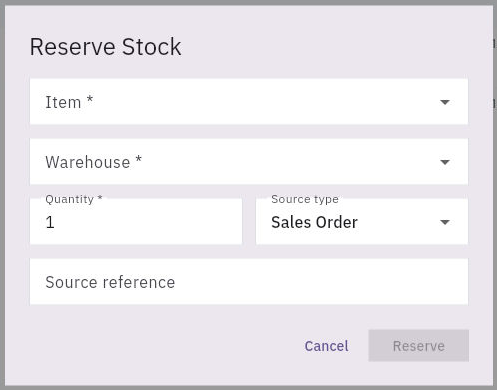
Open Inventory → Reservations and check for an existing allocation for the same demand. Reserve Stock has required Item, Warehouse and Quantity, plus Source type and Source reference. Source types include Sales Order, Transfer, Work Order and Manual. Selecting a type does not create or verify its source record.
Fulfilment tracing and return decisions
Reserve Stock requires item, warehouse and quantity and separately identifies the demand source.
The blank quantity of one is not an approved amount. The initial form does not expose location, lot, expiry or assignee controls; do not assume it automatically chooses the intended bin or quality state. Establish the supported location/tracking treatment before committing. After an authorised reservation, reopen the exact record and compare item, warehouse, source and allocation state alongside Stock.
For a fictional bin containing nine physical packs, two are held and three of the seven accepted packs are reserved for an earlier demand. If those groups do not overlap and no other restrictions apply, four are free for a new demand. A new need for six has a gap of two. Neither the held two nor another person's reservation belongs to the new demand merely because it is urgent.
A reservation is not an issue or recipient receipt. Release of a reservation is not a physical return. Follow the supported fulfilment records and verify the handoff quantity, recipient, source and remaining allocation rather than marking demand complete from an allocation alone.
Trace lots and serials by exact identity
Lots & Serials has Lots, Serial Numbers and Expiring. Lots lists Lot, Item, Qty, Last recorded warehouse, Last recorded location, Manufactured and Expiry. A lot row is one tracked identity, not one unit. The last-recorded header location does not establish that all current movements or balances remain there.
Open the exact lot and compare status, quantity, source receipt and quality/hold controls. Genealogy can connect supplier, receipt, lot and production; read each relationship label. A Finished output received link establishes that recorded relationship. Material issue is not proof of consumed quantity. A missing supplier remains missing rather than inherited from an unrelated receipt.
Use serial origin and expiry evidence separately. An expiry warning is not a new quality decision, and the Expiring view's window should not be assumed identical to the separate Reports family. Confirm the date and eligible quantity before release or use. Do not use hold/release controls merely to discover what happens.
Choose the right return direction
Open Inventory → Returns → Customer Returns for inbound customer goods or Supplier Returns for outbound vendor returns. The helpers describe Customer Request → Receipt → Inspection → Restock / Quarantine / Scrap, and Supplier Return to Vendor → Select Items → Dispatch → Completed. Those are workflow descriptions, not proof that any specific return completed.
New Return distinguishes Direction, Warehouse, the relevant customer/vendor party, Original reference, Item, Quantity and Reason. Match the unit through the item definition because the inspected form does not show a stock-unit field. A returned item that looks similar may still have the wrong SKU, lot, condition or source.
Customer receipt does not immediately make stock available: inspect and choose the authorised disposition. Supplier dispatch does not prove vendor receipt or a financial credit. Do not substitute Procure's accepted-goods return route for an Inventory return without checking its exact scope.
Preserve the original story during recovery
If a returned pack is damaged, keep it identified and restricted under the approved handling process; do not restock it to satisfy a shortage. If a source reference is missing, resolve the original transaction before inventing a link. After an authorised return, compare the saved direction, party, source, item, quantity and status with its movement and location balances.
A useful practical answer for the nine-pack example is: four currently eligible for new demand, two short, previous reservation preserved, held units pending a separate quality decision. If two returned packs arrive later, they do not close the gap until exact identity, condition, disposition and availability are established. A green return status alone cannot replace those checks.
Turn what you learned into the way the team works.
Mark this lesson complete once the workflow exists in your workspace—not simply when you reach the bottom.