Desk course 06 — Reviewing service performance and completing a support journey
Service reporting helps decide what to improve, but a chart is useful only when its population and measure are understood. This chapter connects Overview to individual requests and finishes the course with a small end-to-end exercise.
Part of Desk module course
In this lesson
Service reporting and operational review
Service reporting helps decide what to improve, but a chart is useful only when its population and measure are understood. This chapter connects Overview to individual requests and finishes the course with a small end-to-end exercise.
In this chapter
- Read Overview as a scoped display
- Reconcile summaries with source requests
- Build a reproducible small review
- Complete the support journey with a fresh example
- Evaluate your own readiness
Read Overview as a scoped display
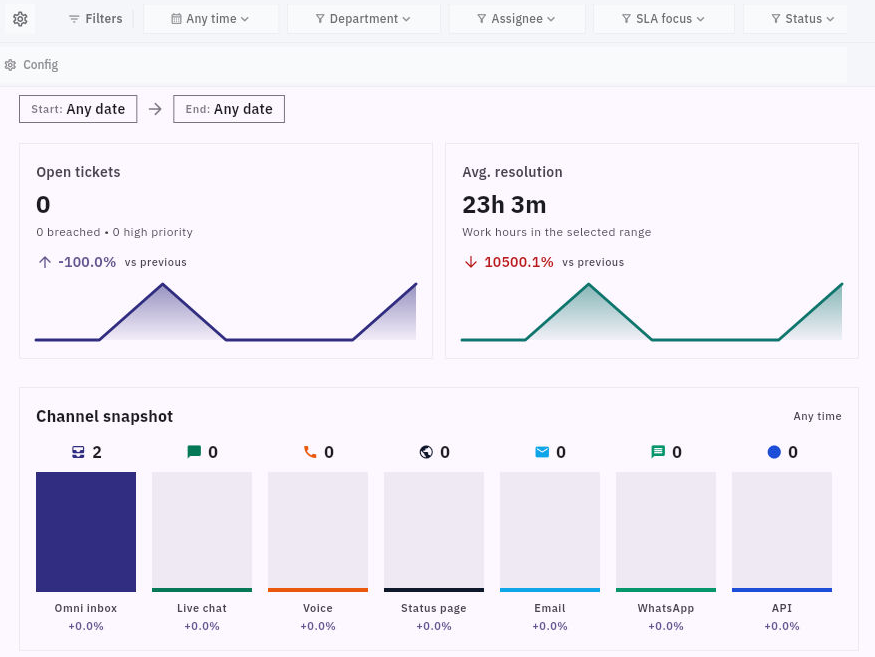
Open the selected Desk's Overview. The observed cards include Open tickets, Avg. resolution, Channel snapshot, Volume trend, SLA alerts and an agent summary. Filters and Start/End date fields affect what is displayed, but do not assume their complete cohort or time basis from a label alone.
Measure interpretation and complete support journey
Open tickets is not automatically every unresolved request in every desk. Average resolution needs a defined start event, finish event, calendar, pause rule and denominator. A percentage versus previous also needs the comparison period and formula. Channel counts may concern requests or events; the displayed word alone does not settle the unit.
A No SLA alerts in range message does not prove that all requests met their targets. It could reflect the selected range, eligibility or other scope. Check the actual requests and policy before reporting compliance.
Reconcile summaries with source requests
Return to Tickets, inspect date, status, department, assignee and SLA filters, and identify the relevant references. Compare each request's status and timing evidence with the intended report population. Do not transfer checkmarks from Tickets to Overview as though their scopes are proven identical.
If Overview shows zero open tickets while a separately loaded queue contains an Open request, preserve both observations and investigate the scope. Do not delete, resolve or reclassify the request to make the display agree. If loading fails, report that limit rather than treating missing rows as zero.
A source example displayed an implausible CSAT percentage without an established response scale or respondent denominator. The appropriate response is not to celebrate the number or silently cap it. Confirm the measure's definition, eligible responses and calculation before drawing a satisfaction conclusion.
The interface evidence does not establish an export or drill-through workflow for every metric. Use only controls actually supported in your environment; do not construct an assumed report route.
Build a reproducible small review
Consider four fictional requests in a defined training period. Two have verified requester outcomes, one has a completed source correction but no requester check, and one awaits clarification. A verified-outcome measure is 2 of 4, or 50 percent. It is not 3 of 4 merely because three have activity.
Now suppose the two completed cases took 30 and 90 minutes under the same explicitly defined elapsed-time rule. Their mean is 60 minutes. That is the average of those two eligible cases, not an average across all four and not proof of the native Overview calculation.
State the denominator and exclusions before comparing periods. If next period includes only easy requests, a lower mean does not by itself prove that a process change caused improvement. Investigate case mix and unfinished work instead of optimizing the easiest visible number.
Use the review to make a bounded operational decision. Repeated unclear-materials requests may justify improving the guide. Repeated access denials may require an authorized access-process review. Those are different causes and should not be merged into a generic “agent performance” explanation.
Complete the support journey with a fresh example
Use this fictional request: “The practice checklist says ‘send it to the usual place.’ I do not know where to put my paper response.” The approved destination is the practice facilitator's collection tray. No electronic transmission or real recipient is part of the exercise.
Prepare a complete intake body that preserves the original phrase, approved destination and boundary. Explain the selected desk, suitable topic/type, priority reasoning and handling responsibility using existing definitions. Do not invent native IDs, options or accounts.
Draft a specialist brief if separate ownership is useful: replace only the unclear destination, keep the rest of the checklist unchanged and return the complete revised text for review. Then review: “Place your paper response in the practice facilitator's collection tray.” The destination is specific, but requester usability still needs its agreed check.
Draft the requester follow-up without claiming it was sent. Identify the correct response surface, intended audience, required retained-message check and receiving evidence. Explain how you would distinguish a saved comment, a sent response, a received copy and the requester's actual use of the instruction.
Finally, decide the lifecycle outcome in two cases. If the requester confirms the correct destination is clear through the approved process, resolution may be justified subject to service policy. If the requester still cannot identify the tray, preserve the original finish condition and continue clarification. A revised sentence alone is not sufficient.
Evaluate your own readiness
You should be able to locate the exact request, preserve its complete context, explain configuration and classification choices, establish assignment, interpret policy and clocks separately, communicate to the correct audience, coordinate supporting work, and justify the final state from the requester outcome.
For native practice, verify each actual saved result independently. If you have only read-only access, complete the planning and interpretation work and identify the exact unavailable practical step. Do not turn correct written reasoning into a claim that a ticket was created, a response delivered or an independent requester accepted the result.
The central discipline is simple: keep the original need, the same request and the actual result connected. Better counts and cleaner states should follow better handling, not replace it.
Turn what you learned into the way the team works.
Mark this lesson complete once the workflow exists in your workspace—not simply when you reach the bottom.