CoBrain course 02 — Reviewing answers and opening authoritative sources
A convincing answer can add a dependency, owner or completion claim that the source never supplied. Review every material sentence, preserve supported information and remove unsupported implications. A citation label is a lead to verification, not proof that you have inspected the source.
Part of CoBrain module course
In this lesson
Answer verification and unsupported implications
A convincing answer can add a dependency, owner or completion claim that the source never supplied. Review every material sentence, preserve supported information and remove unsupported implications. A citation label is a lead to verification, not proof that you have inspected the source.
In this chapter
- Compare the whole draft with allowed facts
- Refine narrowly, then reread everything
- Check record-based answers against the exact source
- Resolve disagreement in the right order
- Practise a bounded conclusion
Compare the whole draft with allowed facts
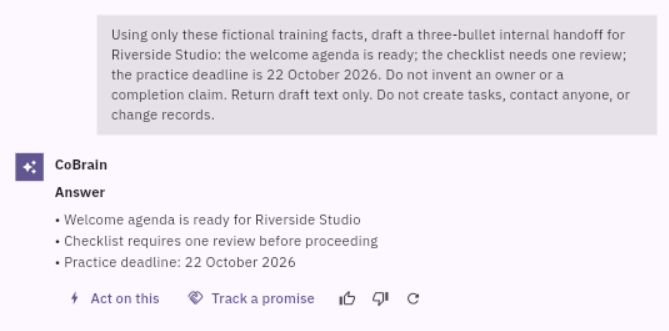
For the three-fact handoff, the allowed meaning is agenda ready, checklist needs one review, deadline Friday. “Checklist requires review before proceeding” adds a prerequisite that was not supplied. It may sound sensible, but it changes the plan.
Claim checking and response refinement
Use a compact claim check:
| Candidate claim | Verdict | Treatment |
|---|---|---|
| Agenda is ready | Supported | Keep |
| Checklist is complete | Contradicts the remaining review | Replace |
| Review must happen before any other work | Unsupported dependency | Remove unless separately established |
| A named person owns the review | Unsupported owner | Leave unresolved |
| Deadline is Friday | Supported | Preserve exactly |
An unsupported statement need not be proved false before removing it from a draft limited to supplied facts. It could be true by coincidence and still lack the required basis.
Refine narrowly, then reread everything
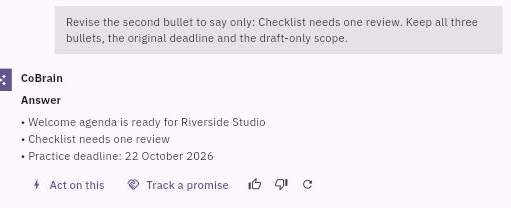
A useful refinement says what to change, what to preserve and what not to do: “Change only the second bullet to ‘Checklist needs one review.’ Keep all three bullets, the original deadline and draft-only scope.” If a live refinement is authorized, enter it in the same conversation and Send message once.
Authoritative record review
Reread the whole returned answer. A correct second bullet does not guarantee the deadline or name stayed unchanged. Do not press Act on this, Track a promise or regenerate merely to finish a wording review; those are distinct controls with separate purposes and effects.
If you reopen the conversation later, compare the retained complete text. That establishes persistence, not a new response, a delivered message or an executed action.
Check record-based answers against the exact source
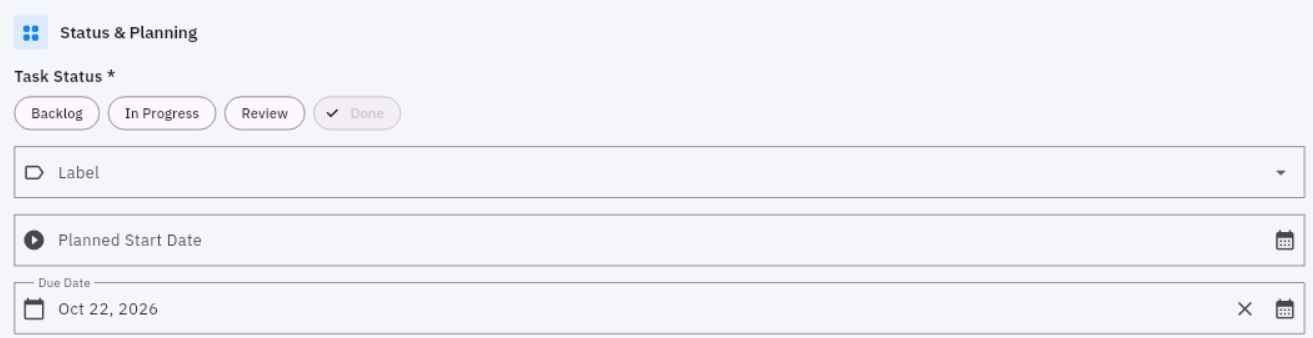
For a task's status and due date, the matching saved task fields are authoritative for those narrow facts. For whether the review actually occurred, the status alone is insufficient; read the acceptance rule and findings too.
Identify workroom, module, Board/container, complete record title or identifier, version where relevant and observation time. Similar names are not enough. An answer based on an old attached page may be stale even when it was accurate when generated.
The demonstrated ordinary source route is global search with Board scope, complete task title, Enter, then the matching result. Confirm Task Title and Select board, then read Status & Planning > Task Status and Due Date without changing them or pressing Update Task.
Readable state and source reconciliation
A generated answer can return a raw Status ID while saying the readable label is unavailable. Do not decode the ID from its shape or memory of another task. Read the actual displayed status through the permitted source route or leave it unresolved. The historical example's source chip was not itself tested as a navigation path, so use supported ordinary navigation rather than promising that chip opens the exact record.
Resolve disagreement in the right order
First check identity: same task and parent context? Then timing: did the source change after the answer? Then representation: two date formats may denote the same calendar day. If identity and timing agree but the answer still conflicts, use the authoritative field for the narrow conclusion and retain the discrepancy.
Do not change the source to make it match the answer. If one view shows an assignee and an editor picker is blank, preserve the disagreement instead of treating whichever value is convenient as definitive.
If access is denied, stop that route. Do not try another account, viewer, download or export to evade the restriction. Ask the authorized owner for the needed field or supported access decision. You can still report what the answer claimed and precisely what remains unverified.
Practise a bounded conclusion
Suppose the source says Review, due October 29, while the answer returns an opaque status ID, the same date and “everything is ready.” Keep the date, obtain Review from the source and reject the readiness claim. A sound conclusion is: “The task is displayed in Review and due October 29. Those fields do not establish completed review or overall readiness.” No task update or communication is needed to finish that source-checking task.
Turn what you learned into the way the team works.
Mark this lesson complete once the workflow exists in your workspace—not simply when you reach the bottom.