Customer issues disappear across channels and queues.
Workroomly Desk
Challenge
What Desk Does
Outcome
Stop Losing Customers to Slow Support.
Support teams should not operate in the dark. Desk gives you SLA-driven ticket operations, automation-powered routing, and full conversation continuity across email, chat, and form intake.
- 40% Faster resolution
- 3x Better SLA compliance
- 100% Conversation visibility
SLA clocks, routing logic, and automation run every ticket with discipline.
Desk actions stay tied to customer revenue, projects, and executive goals.
Support Reality
Most support stacks are fragmented by default.
When conversations, ownership, and SLA obligations are split across inboxes and chat tools, teams spend more time triaging than resolving.
Fragmented Support Stack
Tickets are reconstructed manually across tools, which slows response and hides escalation risk.
- Email inbox overloadMissed threads
- WhatsApp chaosNo audit trail
- Manual ticket assignmentUneven agent load
- No SLA trackingBreach surprises
- Escalations lost in SlackLate intervention
Workroomly Unified Support
Every interaction is captured in one operational timeline so agents and leaders work from the same support memory.
- One ticket timelineFull context
- SLA countdown timersLive control
- Auto-routing rulesBalanced ownership
- Escalation hierarchyPredictable response
- Full customer historyRevenue-aware support
Support teams react too late because signals are scattered.
Desk centralizes timeline, SLA urgency, and queue ownership in one control plane.
Ticket decisions stay visible beyond support, reducing blind spots in operations.
Capability Stack
Enterprise-grade support capabilities, without workflow debt.
Desk is category-credible against Zendesk, Freshdesk, and osTicket, with the execution rigor teams need when support volume scales.
SLA & Priority Control
Keep commitments measurable with configurable service levels and clear breach signaling.
- Custom SLAs per category
- Response time tracking
- Breach alerts
- Escalation timers
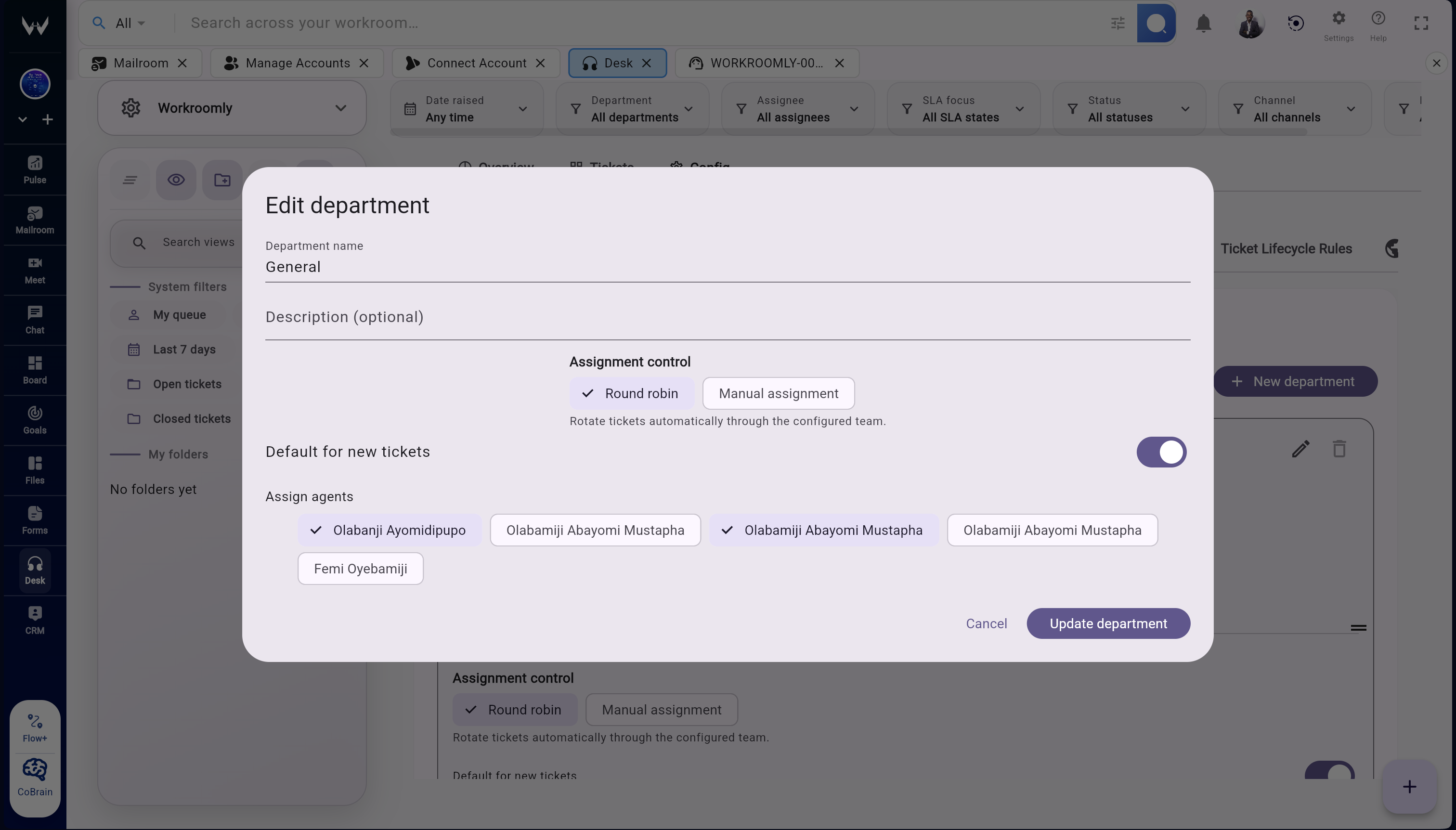
Smart Ticket Routing
Route every ticket to the right queue and owner using rule logic that adapts to workload and expertise.
- Rule-based assignment
- Skill-based routing
- Round-robin logic
- Auto-tagging
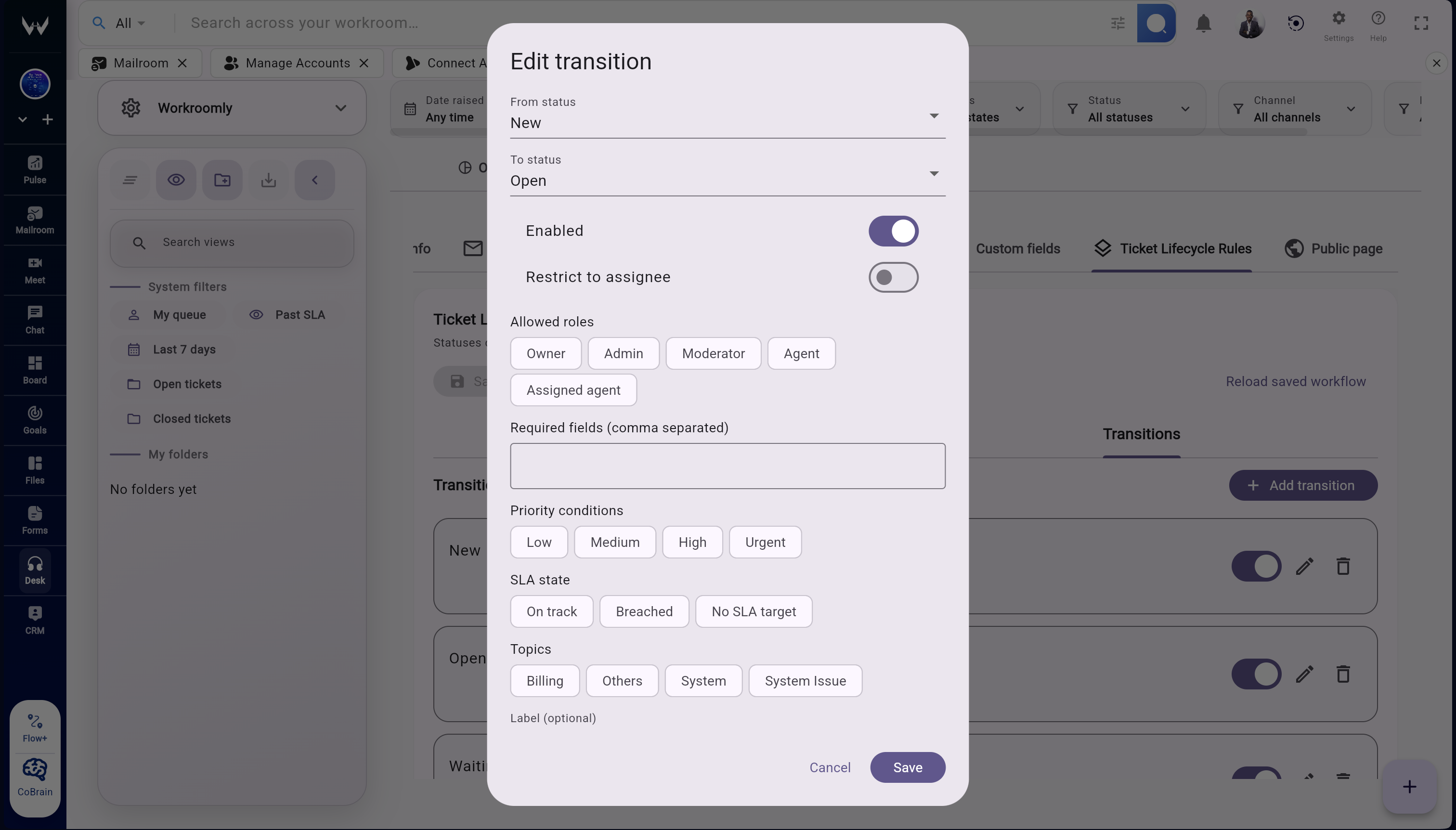
Automation Workflows
Operational automations remove repetitive actions and enforce response consistency.
- Trigger-based status updates
- Internal note prompts
- Auto-close logic
- Customer follow-up automation
Multi-Channel Intake
Capture requests from everywhere into one queue model with shared ownership and traceability.
- Email-to-ticket
- Embedded support forms
- Live chat sync
- Internal issue capture
Reporting & Team Performance
Use live analytics to keep support quality predictable across every queue and shift.
- SLA compliance dashboards
- Agent performance analytics
- Resolution time trends
- Escalation tracking
Support quality drops when queues scale faster than process discipline.
Desk adds SLA rigor, automation control, and channel-wide intake governance.
Ticket execution feeds performance insights the rest of the business can act on.
Execution Flow
Run support with operational clarity in five steps.
Ticket Captured
Email, chat, form, or internal request enters a structured ticket timeline.
Routed Automatically
Assignment rules send the ticket to the right queue and owner immediately.
SLA Countdown Activated
Priority thresholds start automatically with response obligations in view.
Escalated if Needed
Breach risk triggers hierarchy-based escalation and internal coordination.
Resolved & Logged
Closure updates reporting, team performance data, and customer history records.
Unstructured support handoffs make response quality inconsistent.
Desk applies one consistent operating sequence to every ticket lifecycle.
The same flow becomes visible to leadership, delivery, and revenue teams.
Connected Advantage
Desk is stronger because support is connected to business context.
Traditional helpdesks can process tickets. Workroomly Desk can coordinate outcomes across revenue, delivery, communication, and strategic goals.
Traditional Helpdesk
Most systems keep ticket data isolated from revenue and execution decisions.
- Isolated ticket data
- No revenue context
- No execution sync
Workroomly Desk
Support decisions become company decisions because every escalation has surrounding context.
- CRM shows customer deal history
- Boards auto-create resolution tasks
- Meet escalates complex cases with AI notes
- Mailroom ties business email to tickets
- Goals align support SLAs to company OKRs
| Dimension | Traditional Helpdesk | Workroomly Desk Advantage |
|---|---|---|
| Customer Context | Limited Ticket history only, with revenue and account nuance outside the support surface. | Revenue-Aware CRM context shows deal history, account value, and relationship signals during support handling. |
| Resolution Execution | Manual Escalations and fixes are usually pushed to other systems without automatic sync. | Orchestrated Boards can auto-launch resolution tasks with owners, due dates, and dependency tracking. |
| Complex Escalations | Fragmented Calls and follow-ups happen outside the ticket thread with limited memory. | Connected Meet escalations run with AI notes and action capture linked back to the original ticket. |
| Communication Continuity | Split Business email responses often detach from ticket and team context. | Unified Mailroom keeps business email tied to ticket operations and escalation history. |
| Strategic Alignment | Weak SLA metrics rarely connect directly to company goals and leadership targets. | Measurable Goals maps SLA outcomes to OKRs so support performance is managed as a strategic lever. |
Support teams own urgency but lack business context to prioritize correctly.
Desk adds full ticket rigor plus escalation intelligence across every channel.
Connected modules turn ticket handling into coordinated revenue protection.
Industry Use Cases
Built for high-stakes support environments.
Desk adapts across industries where response quality, SLA discipline, and escalation precision directly impact retention.
Fintech & Loan Apps
Challenge: Compliance-sensitive customer issues escalate too late.
Desk move: SLA tiers, escalation paths, and auditable timelines keep regulated support controlled.
SaaS Companies
Challenge: Product bugs and account issues get split across support and product teams.
Desk move: Auto-routed tickets and Boards-linked tasks keep support and delivery execution synchronized.
Agencies
Challenge: Multi-client requests overload inboxes and blur accountability.
Desk move: Queue rules, client history, and escalation governance maintain response quality at scale.
Edtech Platforms
Challenge: Enrollment and learner support spikes create SLA failures.
Desk move: Automated triage and performance dashboards stabilize peak-period support operations.
Different industries face different support pressure patterns and risks.
Desk provides configurable routing, SLA, and escalation operations per context.
Cross-module visibility keeps industry-specific support outcomes tied to company performance.
Support That Protects Revenue.
Replace fragmented response habits with SLA-driven execution, automated escalation, and full business context on every ticket.
Slow, disconnected support workflows quietly increase churn risk.
Desk enforces SLA velocity and escalation precision from intake to closure.
Support outcomes become visible operational signals for growth and retention.